
Guides
Part of What should you ask before commissioning a custom workbench maker?
5 things to understand about custom workbench makers
Ordering a custom bench for a small shop: survey the access route first, specify knock-down assembly, and plan how a heavy top reaches a basement or attic.
What to take away
- Survey the access route before you agree dimensions. The staircase, not the room, is usually what limits the bench.
- Specify knock-down assembly for anything going upstairs or into a basement. It is a design decision, not a delivery detail.
- A small shop needs a bench that earns its floor. Ask for features that replace other furniture.
- Delivery day plans fail on the last three meters. Clear the room, not just the doorway.
A custom bench suits a small shop more often than a large one. A standard bench rarely fits an awkward room, and the compromises show up daily.
That advantage disappears if nobody measured the route in. That is the most common way a well-made bench ends up in a garage it was not built for.
Survey the route before the design
Walk the path a bench top will take and record every constraint:

- Every door width, including the narrowest point with the door on its hinges.
- Every corner, and the diagonal you can actually turn.
- The staircase width, the headroom over it, and the landing at the top.
- Any handrail that cannot be removed.
- The floor surface at each stage, and whether it will take a roller.
Give this to the maker in writing. A maker with the survey will design around it. A maker without it will build to your room dimensions and discover the corner on delivery day.
Stairs deserve their own thought
Carrying a heavy top up or down stairs is the most dangerous part of the project. The federal rule on stairways covers tread condition, uniform riser and tread dimensions, handrail provision and the loads stairways carry. Employers must comply on their premises.
In a house it is a checklist for whether your stairs are actually suitable: uniform steps, a solid handrail, nothing on the treads, and adequate light.
If the answer is doubtful, that settles the knock-down question.
Specify knock down at design stage
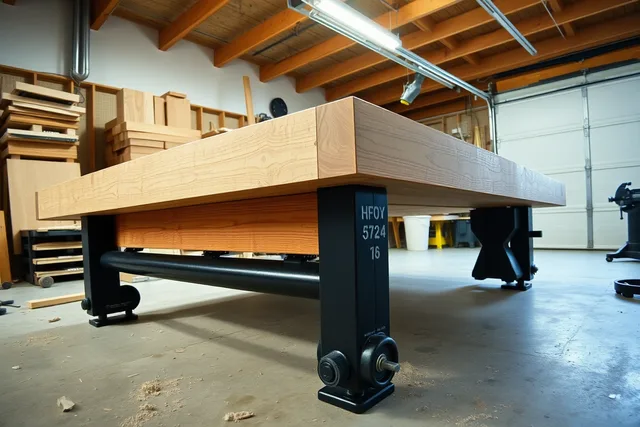
A base that comes apart into legs and stretchers, and a top that arrives separately, changes what is possible. Bolted joints with captive nuts hold up well to repeated assembly and can be retightened. Glued joinery cannot come apart at all.
Say this before the drawing is agreed. Retrofitting knock-down joinery to a glued base means rebuilding it.
Ask the bench to do more than one job
In a small shop the bench should absorb functions that would otherwise need furniture:
- A lower shelf sized for the storage boxes you already own.
- An end that matches your machine table height, so it works as outfeed.
- A removable or replaceable top section for messy work.
- Casters that lift the bench onto fixed feet, if the room must clear.
Delivery day
If the bench arrives on a pallet, something must move it, and pallet trucks and forklifts have their own operating rules.
OSHA's standard for powered industrial trucks covers operator training, load handling, and traveling with a load. A driver delivering to a residential address may only leave the pallet at the curb.
Ask before delivery day where the driver can reach, and plan the last stretch yourself.
Our commissioning watchlist covers evaluating a maker, and our small-space bench setup guide covers living with the result.
Common questions
Should I measure or ask the maker to? Measure yourself and send it. You know the house; they will be working from your numbers regardless.
Is a knock-down bench less rigid? It can be, and good bolted joinery is close. Say rigidity matters and let the maker solve it.
What if it does not fit on the day? Agree in advance who pays for storage, modification or return. This is the most common dispute.
Can a bench be assembled in the room? Usually yes, if it was designed that way. Confirm there is room to work around it once inside.