Industry
Part of What should you ask before commissioning a custom workbench maker?
5 parts of learning from bench makers, explained
Ways to learn from a custom bench maker: paid studio days, shop time with supervision, structured training routes, and how such training gets funded.
What to take away
- Learning from bench makers has five parts: a paid studio day, rented shop time under supervision, a short course at a school or guild, a registered apprenticeship, and the notes you write yourself afterwards.
- No studios are named here. We have attended none of them, and a recommendation without attendance is just a guess.
- Paid studio days with a working maker are the fastest way to learn bench work, and the least advertised.
- Ask what you will do with your hands. A day of watching is worth far less than a day of cutting.
- If you want this as a trade rather than a hobby, structured routes exist and there are documented ways of paying for them.
Bench makers rarely run formal classes. Most teaching happens informally, so you usually have to ask rather than book, and the asking is where most people stop. There is no listing site for this, no timetable and no advertised price. The availability stays invisible until you make contact directly.
The five parts of learning from a bench maker
| Part | What it gives you | What to confirm first |
|---|---|---|
| 1. Paid studio day with a maker | One-to-one attention on your actual problem | What you will do rather than watch |
| 2. Rented shop time with supervision | Machine access plus someone to ask | How much supervision is real |
| 3. Short course at a school or guild | Structure, a syllabus, other students | Machine-to-student ratio |
| 4. Registered apprenticeship | A credential and paid experience | Whether the program is registered |
| 5. The notes you write that evening | Sequence and judgment you can repeat | Whether you recorded the order of steps |
The first part is the one most people never consider, and it is often available. Many working makers will take a day of teaching when the queue allows, particularly out of season. A full day typically costs $250 to $600 in most markets as of 2026. Makers with long waiting lists sit at the top of that range.
The second part is machine access with a person nearby. Community workshops such as Artisan's Asylum in Somerville, Massachusetts, and NextFab in Philadelphia rent shop time by the month and run their own intro classes. Membership typically runs $50 to $200 a month as of 2026, and woodshop privileges sometimes cost extra.
The third part is easier to price, because schools publish catalogs. North Bennet Street School in Boston runs a full-time Cabinet and Furniture Making program of about two years, plus shorter continuing-education workshops. The Center for Furniture Craftsmanship in Rockland, Maine, teaches a 12-week intensive and week-long summer courses.
Marc Adams School of Woodworking in Franklin, Indiana, runs week-long and weekend classes. Palomar College in San Marcos, California, awards a cabinetmaking and millwork certificate through its community college program. Week-long courses at craft schools typically cost $400 to $900, plus materials, tools and lodging.
Woodcraft and Rockler retail stores run evening classes in many cities, usually $50 to $150 per session. Regional groups such as the Society of American Period Furniture Makers run chapters and shop events for members.
How to ask for a studio day
Be specific about what you want to learn, offer to pay properly for the maker's time, and be flexible on dates. Vague requests to hang around a shop are usually declined, and reasonably so.
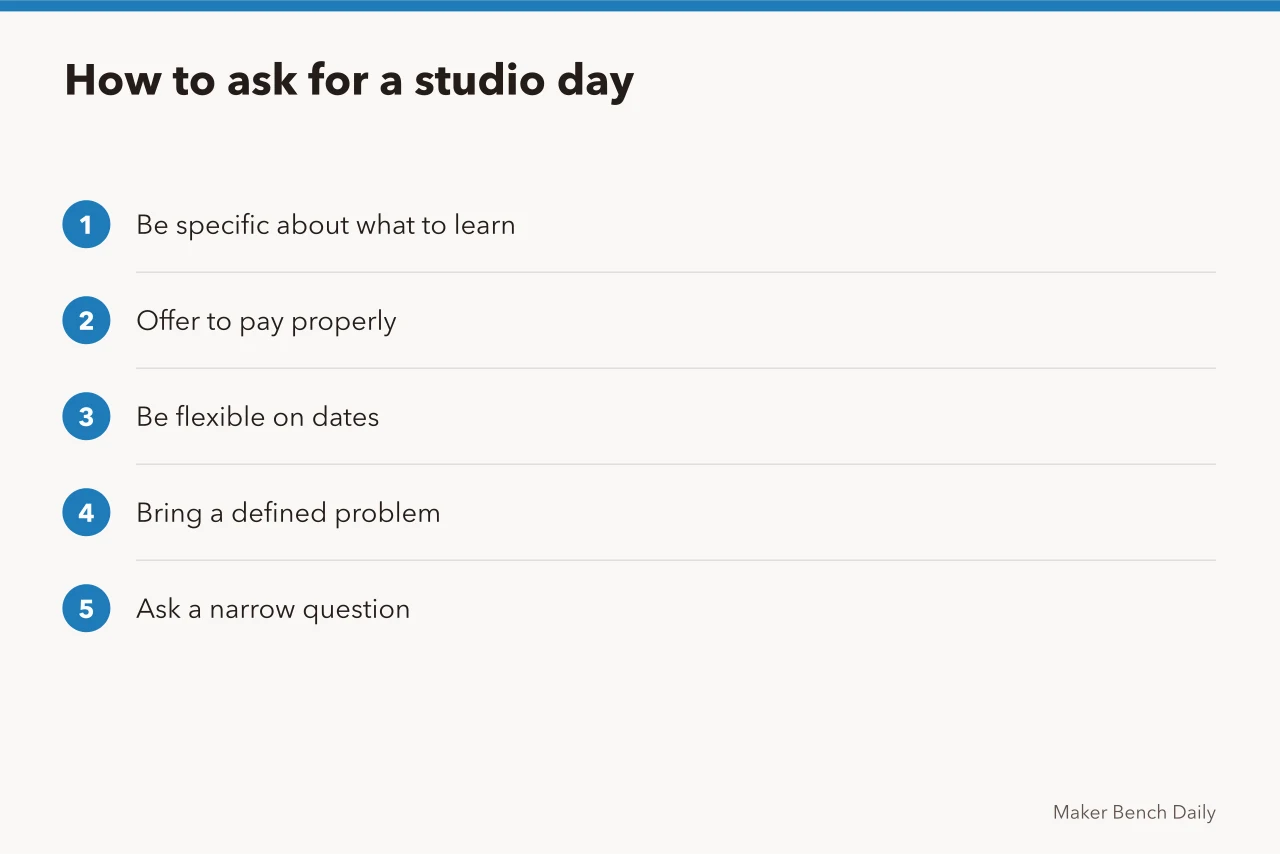
Bring a defined problem: flattening a top, fitting a vise, cutting one joint at a scale you have not attempted. A narrow question is easier to teach and easier to price.
What to establish before you go
- What you will physically do, and what you will watch.
- Whether you bring stock or it is supplied.
- What protective equipment you need to bring.
- Whether photography is allowed, and what you may publish.
- What happens if you are slower than expected.
Part four: registered apprenticeship and how it gets funded
Some people take one studio day and realize they want the work rather than the object. The federal registered apprenticeship academy explains how registered programs are built and run. It is worth reading whether you want to join one or eventually sponsor one.
Registered Apprenticeship programs are sponsored by employers, unions or employer groups. They combine paid on-the-job training with related classroom instruction.
Cost is the usual obstacle, and it is more solvable than people assume. The federal overview of investments, tax credits and tuition support sets out the funding routes that exist around apprenticeship, including support available to employers who take people on.
Neither of those turns a weekend class into a career. They do mean that a serious change of direction has a documented path rather than only a leap.
Part five: take the method home, not the shopping list
What transfers from a day with a maker is sequence and judgment: how they check for flat, how they decide a board is ready, what they do when a glue-up goes wrong. Write it down that evening while it is fresh, in the order you did it. The order is the part you cannot look up later.
Our commissioning watchlist covers hiring a maker rather than learning from one, and our guide to bench-building classes covers formal course options.
Common questions
Will a working maker really teach me? Some will, for a fair price and at a time that suits their queue. It costs nothing to ask politely.
Is one day enough to learn anything? For one technique, yes. For a whole bench, no.
Should I expect to take work home? Ask first. Some studio days produce an object, many produce practice cuts and notes.
Is a guild membership worth it? Often, for the shop access and for having people to ask. Check what equipment members can actually use unsupervised, since that varies widely between groups.