Reviews
Part of Modular workbenches comparison: criteria, not product picks
What to buy first for a modular workbench: vise, dogs and a stop
The bench hardware that pays off first: one vise, dogs that fit your grid, holdfasts, a stop, and the work-holding that keeps hands away from cutters.
What to take away
- Work holding is the first purchase and the last one people make. A bench without it is a table.
- One vise, well fitted, beats three vises fitted badly. Position matters more than type.
- Every dog, holdfast and stop must fit the grid you chose for your modular workbench. Buy the grid first, in effect.
- Good work holding is a safety purchase. Anything that keeps hands away from a cutter is doing guarding work.
- The short lista Record Irwin or Veritas vise, Veritas or Rockler dogs, a Gramercy or Veritas holdfast, a Veritas Planing Stop.
A first rig that works: a Veritas Quick-Release Sliding Tail Vise from Lee Valley at the end of the bench, or a Record Irwin 52 1/2 front vise at the front. Add Veritas dogs, a Gramercy Tools holdfast and a Veritas Planing Stop.
Typical US prices as of 2026 run $200 to $400 for the vise, $12 to $20 per dog, $60 to $90 per holdfast, and $40 to $55 for the planing stop.
Match the shaft and the dog to your hole size first. An accessory sized for one grid is useless on another, and most benches sit unused because nothing holds the work.
First: one vise, positioned properly
A single well-placed vise transforms a bench. Front position for edge work and joinery, end position for holding boards flat along the top. Which you need depends on the work, not on which looks more traditional.
Five vises cover most benches:
One vise, positioned properly
- Record Irwin 52 1/2cast-iron, quick-release front vise for edge work and joinery. Typically $200 to $300.
- Veritas Quick-Release Sliding Tail Vise, sold by Lee Valleymounts flush at the end and works with a row of dog holes. Typically $300 to $400.
- Benchcrafted Glide leg vise with the Crisscrosshandwheel leg vise that resists racking on wide panels. Typically $700 to $900 for the vise and crisscross hardware.
- Yost M9WW9 inch cast-iron front vise and a common first buy. Typically $150 to $250.
- Wilton 63187heavier cast-iron front vise for hard use. Typically $250 to $350.
Fit matters more than model. The jaw should close parallel under load, the screw should not bind, and the mounting must reach a solid part of the bench rather than the overhang. A vise bolted to an unsupported edge will pull the top up.
Second: dogs, holdfasts and a planing stop
These are cheap, and they cover most holding jobs that a vise alone handles badly:
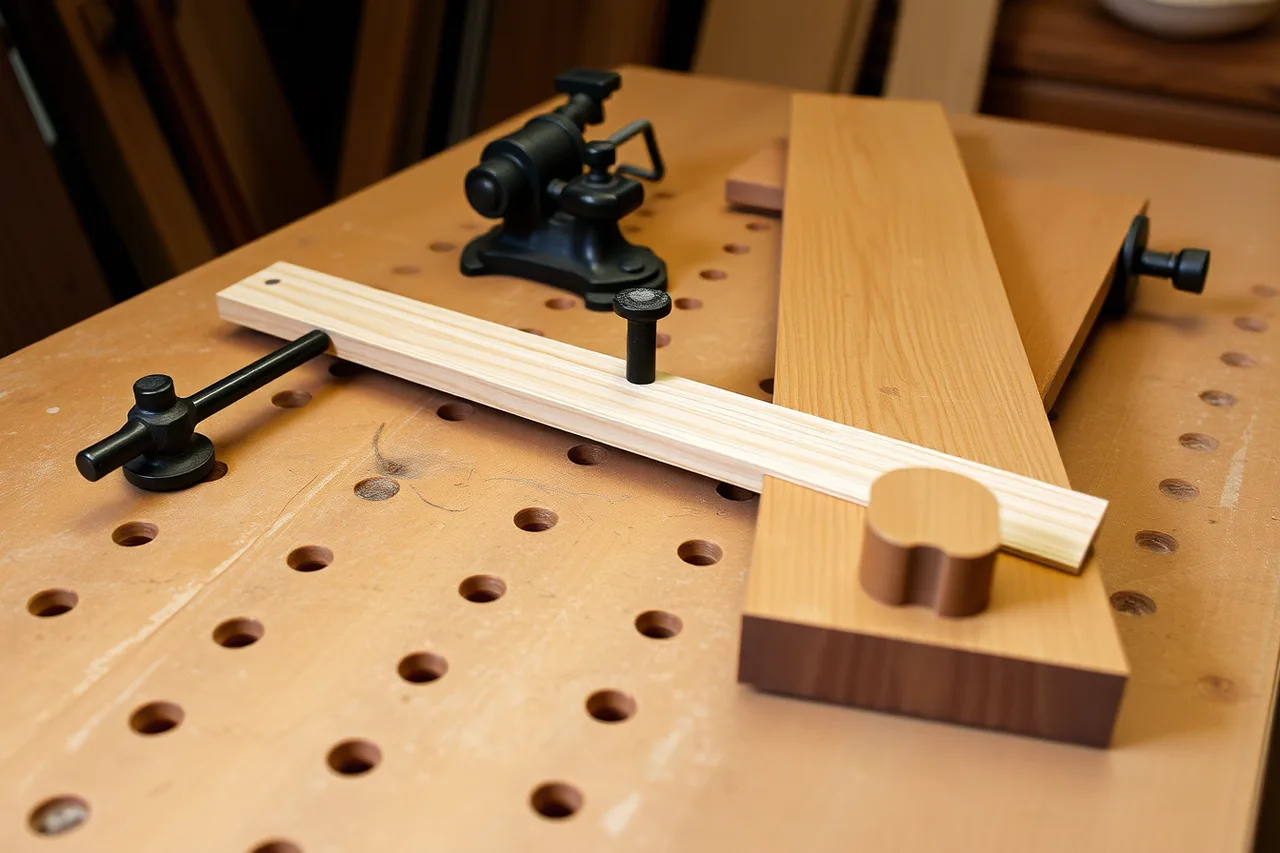
Dogs, holdfasts and a planing stop
- Bench dogs to trap a board between the vise and the top.
- A holdfast or two for clamping down anywhere on the grid.
- A planing stop so long boards can be worked without clamping at all.
- One low-profile stop for sanding and routing, so nothing is held by hand.
Bench dogs. Veritas Bench Dogs from Lee Valley are spring-loaded and fit 3/4 inch holes, typically $12 to $20 each. Rockler Deluxe Bench Dogs take the same 3/4 inch hole and run about $20 to $35 each. Sjobergs dogs are cut for that brand's 1 inch holes, typically $15 to $25 each.
UJK Parf Dogs, sold by Axminster Tools, use 20mm shafts for MFT-style tops and cost about $40 to $60 a pair. Veritas Wonder Pups clamp low and sit flush for sanding and routing, typically $30 to $45 each.
Holdfasts. Gramercy Tools Holdfasts from Tools for Working Wood take a 3/4 inch hole and sell in pairs, typically $80 to $100. The Veritas Holdfast adds a screw adjustment and runs about $60 to $75 each.
Crucible Tool makes a heavier cast-iron holdfast with a 1 inch shaft option, typically $110 to $140 each.
Planing stops. The Veritas Planing Stop drops into a 3/4 inch dog hole and its toothed face grips the end of a board, typically $40 to $55. The Festool MFT-SP set fits 20mm MFT holes with two stops and clamps, typically $150 to $190.
Rockler Bench Cookies Plus hold a workpiece for sanding without any dog holes, typically $20 to $30 for a set of four. Buy them in the size that matches your holes, and drill the holes before you buy anything else.
Third: the things that keep hands away
Work holding does more than add convenience. A stop, jig, or hold-down keeps your hands away from the cutter.
OSHA's machine guarding standards page collects rules requiring the point of operation to be guarded, and it describes feeding and ejection methods that keep operators clear of that point.
Those rules apply to employers, not hobbyists. The underlying principle is what a good bench fixture does.
If a cut requires you to hold the work by hand near a spinning cutter, the fixture is missing, not the technique.
A word about gloves
Gloves feel like protection and are sometimes the opposite. The federal rule on hand protection requires selection by task, hazard and glove performance.
Light leather-palm gloves such as the Wells Lamont 1132, typically $15 to $25 a pair, suit rough timber, splintery sheet edges and finishing chemicals. Keep hands bare near anything rotating, where a glove can catch and pull your hand in.
What to buy later, not first
| Item | Why it waits |
|---|---|
| Second vise | Solve holding with dogs and stops before adding hardware |
| Full accessory set | You will use three of the twelve pieces |
| Benchcrafted Glide leg vise, if you started with a Yost | A $700 plus upgrade; dogs and stops pay off first |
| Extra bench modules | Add when a real workflow demands it |
| Deluxe caster kit | Only if the bench genuinely moves |
Our modular bench comparison covers how to choose the bench itself, and our guide to pricing a bench build covers what all this actually costs.