
Features
Garage workshop ideas worth the effort, from light to fire cover
Fifteen garage workshop ideas worth the effort in 2027, from mobile everything and better light to fuel storage, fire cover and keeping the car space.
What to take away
- A garage shop lives or dies on how fast it converts back into a garage. Design for the changeover.
- Never run an engine-driven tool inside, even with the door open. Carbon monoxide is the one garage hazard that gives no warning.
- Cold, damp and dust are the three background conditions a garage adds to every project.
- Fire cover and fuel storage deserve a decision, not an assumption, because garages are where fuel and ignition sources meet.
Garages make good shops because they have a big door, a concrete floor and tolerance for mess. They make bad shops because they are shared, unheated and full of fuel. These fifteen ideas address that trade directly.
Fifteen garage shop upgrades, from lighting to fire cover
- Put every machine that blocks a walkway on a locking mobile base. Storage. Typical $40 to $120 per base, about 30 minutes to fit.
- Set one wall as the permanent assembly wall and store nothing against it. Storage. No cash cost, one afternoon to clear it.
- Add a second light source at bench height so shadows show surface defects. Light. Typical $40 to $150 for an LED fixture, about an hour to mount.
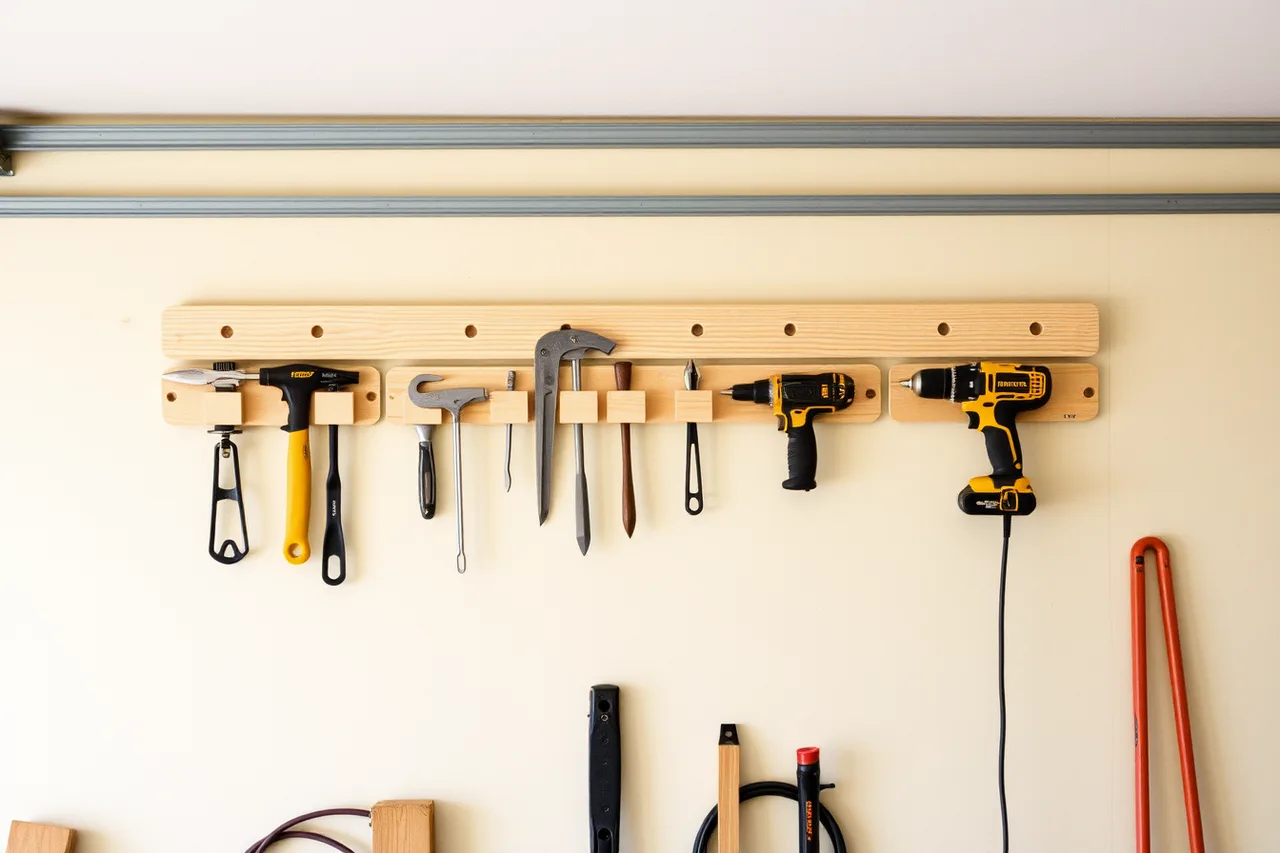
- Fit a French cleat wall instead of fixed cabinets, so storage follows the layout. Storage. Cleats on 16 inch centers land on studs; typical $2 to $5 per linear foot.
- Store sheet goods upright and restrained at the bottom. Storage. Typical $40 to $120 for a cart or brackets, about an hour to set up.
- Keep a dedicated sharpening station, however small, so edges get maintained. Storage. No build needed; a stone and strop run $30 to $120.
- Insulate the garage door if you work through winter; it is the largest cold surface. Climate. Typical $100 to $400 for a kit, a weekend for a two-car door.
- Run a dehumidifier in humid months to keep cast iron and steel from rusting. Climate. A typical 20 to 30 pint unit suits a one-car garage and costs $150 to $300.
- Mount a shallow tool cabinet on the wall the car parks beside, not a deep one. Storage. Typical $60 to $250, or build one from offcuts.
- Use a folding outfeed table that stows flat against a wall. Storage. Typical $80 to $300, one to two hours to fit.
- Keep a wheeled bin for offcuts with a fixed volume, emptied when full. Storage. Under $30 for the bin, no build time.
- Fit a proper extractor connection at the machine you use most. Dust. Typical $20 to $60 for hose and fittings; the port sets the size.
- Mark the tire line on the floor so the shop never grows past it. Layout. Tape or floor paint, under $30, about an hour.
- Keep a first aid kit and a fire extinguisher near the door, both checked. Safety. A typical garage unit carries a 2-A:10-B:C rating and costs $30 to $70.
- Photograph the room empty before you build anything, and keep the picture. Layout. No cost, and it is the record you check before adding storage.
The carbon monoxide rule has no exceptions
Gasoline generators, pressure washers, compactors, and any other engine-driven tool produce carbon monoxide. It is colorless, odorless, and quickly fatal in an enclosed space.
The Consumer Product Safety Commission's guidance on generators and engine-driven tools says never run them inside a home, basement, or garage, even with doors and windows open. The gas builds up faster than ventilation clears it.
If your garage is attached to the house, this extends to the house. Follow your locally adopted building or fire code and the alarm maker’s placement instructions. The International Residential Code (IRC), where adopted, generally calls for carbon monoxide alarms outside each sleeping area and on each level of the dwelling; local adoption controls. NFPA 72 is the national fire-alarm standard.
Fire cover is a decision, not a default
Garages hold fuel, solvent, sawdust, batteries on charge, and often a water heater. OSHA’s portable fire extinguisher standard, 29 CFR 1910.157, applies to workplaces, not private homeowners. NFPA 10, Standard for Portable Fire Extinguishers, provides guidance on extinguisher selection, placement, and inspection; local codes may also apply.
Match the extinguisher to the hazards: Class A covers ordinary combustibles such as wood and sawdust, Class B covers flammable liquids such as gasoline and solvents, and Class C covers energized electrical equipment. A multipurpose ABC extinguisher covers those classes; a 5-pound ABC unit is a practical starting point for a home garage, but check its label and local requirements. Mount it visibly and within reach near an exit, where a fire is less likely to block access. The example 2-A:10-B:C rating uses those class letters. The workplace standard calls for a monthly visual inspection and annual maintenance; using that schedule at home is a useful baseline. An extinguisher is for a small, contained fire—leave and call emergency services if a fire grows or blocks your exit.
Keep the garage part of the garage
Keep gasoline in an approved, tightly closed fuel can, away from ignition sources, and follow the container label and local fire code. For larger quantities of flammable liquids, use a listed flammable-liquid storage cabinet; a regular shop cabinet is not a substitute. Our first-time buyer comparison compares tools for a first garage shop.
Common questions
Is an attached garage safe for finishing work?
Should I heat the garage?
What is the best flooring for a garage shop?
How do I keep tools from rusting?
In this guide
- How to photograph a garage workshop: fix the light, frame at working height, and say what the picture leaves outA guide to photographing a garage workshop: fixing mixed light, framing at working height, avoiding unsafe practice in photos and noting what was tidied or cropped.
- Garage tools compared: fuel type matters more than priceCorded, cordless, pneumatic and fuel tools each carry a different cost in a home garage, and the power source decides more than the badge does.
- A weekend plan turns garage workshop ideas into finished habitsA two-day plan for a garage shop: audit the room on Saturday morning, fix the hazards you find, then practice the cuts that everything else depends on.
- 4 things worth knowing about garage workshop storage ideasStoring garage workshop materials: lumber and sheet goods that stay flat, finishes and fuel kept away from ignition, and rags that can heat on their own.
- Beginner garage projects, each built to teach exactly one skillSix small garage workshop projects chosen to teach one skill each: sharpening, square crosscuts, flat panels, drilling accurately, and finishing cleanly.