
Features
Part of Workshop Ventilation How It Works: Capture at the Source
Blast gate, downdraft box, switched circuit: one ventilation skill per build
Five small ventilation builds that teach one thing each: a blast gate, a separator lid, a downdraft box, a machine hood, and a properly switched circuit.
What to take away
- Build the small pieces yourself. Hoods, gates and boxes are where a home system is won or lost, and they are all simple to make.
- Each project below isolates one skill, so when it fails you know what to change.
- Do not design duct sizing from a project article. Take that from published engineering guidance for your operation.
- Anything involving fixed wiring is a job for a qualified electrician, whatever the internet says.
The five builds here, a blast gate, a separator lid, a downdraft box, a machine hood and a switched circuit, each teach one ventilation skill. The expensive parts of a dust system are bought. The effective parts are usually made to fit one machine in one room.
No manufacturer sells a hood shaped for the gap between your saw and your wall. That is good news for a beginner: the highest-value work in the whole system is also the simplest to build.
Five builds, one skill each
| Project | Skill it isolates | How you know it worked |
|---|---|---|
| Blast gate in a 1/2 inch plywood body, 4 inch port | Accurate slot cutting and fit | It slides freely and seals when closed |
| Separator lid on a 30 gallon drum (Oneida Dust Deputy, Rockler Dust Right) | Sealing a joint under suction | The drum does not collapse and the filter stays clean |
| Downdraft sanding box, 24 by 24 inches, 3/8 inch holes | Even airflow across a surface | Dust leaves the workpiece rather than rising |
| Hood for one machine, built to the cutter | Enclosure geometry | Visible dust stops escaping at the cutter |
| Switched, labeled 120 volt power for the collector | Planning fixed services | You can start the collector without leaving the machine |
Build them in that order. Each one teaches something the next one needs.
Blast gate: two 6 inch plywood plates and a 4 inch port
Cut two 6 by 6 inch plates of 1/2 inch plywood and three spacer strips of 3/4 inch stock. Rout a 1/4 inch slot in each plate, stack the parts dry, and check that the slots align before gluing.
Glue the spacers between the plates at the top and bottom, and keep the slot clear. Slide in a 1/8 inch hardboard or aluminum gate, then screw two 4 inch collars to the outside faces: PVC male adapters or metal flanges.
The gate should slide with two fingers and seal when closed. If it drags, sand the slot or line it with UHMW tape. Rockler sells a 4 inch Dust Right blast gate for about $20 to $30, and Lee Valley lists an aluminum gate in the same range.
Separator lid: 3/4 inch plywood on a 30 gallon drum
Cut the lid to the drum rim and rout a rabbet that drops over the lip. A rabbet about 1/4 inch wide and 1/2 inch deep fits a standard 30 gallon steel drum. Seal it with closed cell foam weatherstrip or a bead of silicone, because that joint is the whole job.
Fit two 4 inch ports: one elbow aimed down inside the drum, one straight to the collector. The down elbow spins dust out of the airstream before it reaches the filter.
Oneida Air Systems sells the Dust Deputy DIY cyclone for roughly $60 to $80 and the Super Dust Deputy 4/5 for roughly $200 to $250. Rockler's Dust Right separator lid, typically $60 to $70, clamps onto a standard drum. A shop-made lid holds its own against both when the rabbet is tight.
Downdraft box: 24 by 24 by 6 inches
Build the box from 3/4 inch plywood with a 1/4 inch pegboard top, drilled or punched at 3/8 inch holes on 1 inch centers. Add one 4 inch port in a side and gasket the top edge so air enters only through the holes.
Leave a 2 inch plenum between the pegboard and the box floor so the draw spreads across the whole top. Tape off the holes outside the working zone, since open area sets the airflow. Rockler sells a ready downdraft table, typically $300 to $450, which is the fair comparison if you would rather buy the weekend back.
Switched circuit: plan it, then hand it over
The fifth build is a switched, labeled circuit for the collector. Plan where the switch goes, what it controls, and how it is labeled. The wiring itself belongs to a qualified electrician.
Draw a dedicated 20 amp, 120 volt circuit on 12 AWG copper. Put the switch box within arm's reach of the machine and label the breaker at the panel.
Start with the hood, not the machine
The hood is where capture actually happens. It is the piece almost nobody buys correctly for their own machine.
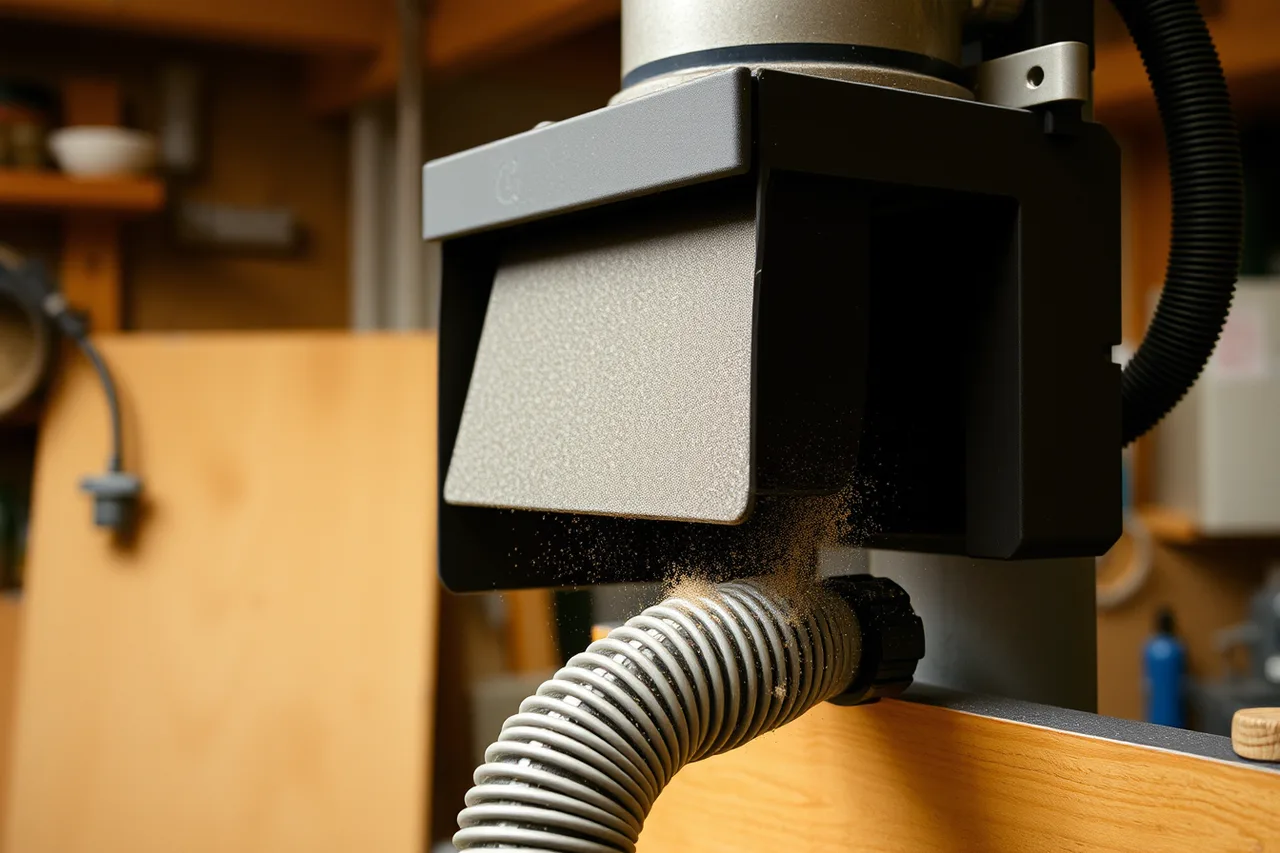
Build a hood that surrounds the cutter on three sides and sits within an inch or two of the stock. Plywood, sheet metal and clear polycarbonate all work; plastic lets you watch the cut and costs less than steel.
A starting size: 2 inches wider than the cutter on each side, 4 inches deep, with a 1 inch lip past the blade. Screw the hood to a plywood bracket that clamps to the table and seal the corners with silicone.
Give it a 4 inch port at the back and a lip that reaches past the blade. Leeway Workshop's Shark Guard is a blade guard with a dust port, sold by saw model, so the price varies; expect a few hundred dollars with the port.
An overarm guard such as the Excalibur from General International is a larger, pricier option. A shop-built hood takes an afternoon.
OSHA's page on wood dust control options sets out the range of measures that reduce exposure: enclosure, local exhaust, housekeeping, and work practice changes. It is written for workplaces and describes the same hierarchy any home shop should follow: enclose the source, capture what escapes, clean up what settles, protect the person last.
The takeaway for a build is that geometry beats horsepower. A close, well-shaped enclosure connected to a modest machine outperforms a distant open port connected to a large one.
The electrical project is the one to hand over
A collector that has to be switched on across the room does not get switched on. The fix is a switched outlet or a remote at the machine, and the wiring part of it belongs to a qualified electrician.
A switched outlet is one of the weekend ventilation fixes that a two-day practice plan can cover. iVac sells an automatic 110 volt switch, typically $60 to $90, that turns the collector on with the tool.
Penn State Industries lists the Long Ranger remote at roughly $60 to $80. A 20 amp toggle switch from Leviton or any hardware store costs about $5 to $10, and its circuit needs 12 AWG copper.
The construction rule on wiring design and protection covers grounding, ground-fault protection and branch circuits. Use that vocabulary when you describe the job to whoever quotes it.
Employers carry that obligation on a job site, not you at home. Knowing the terms makes it easier to ask for the right thing. What you can do yourself is the planning: decide where the switch goes, what it controls, and how it is labeled.
Keep the records as you build
Photograph each piece before it is installed, write the dimensions on the sketch, and number the gates. A system built in five weekends becomes unmaintainable if the record lives only in your memory.
Our ventilation overview explains where each of these pieces fits, and our garage projects list covers the same one-skill approach applied to woodwork.