Guides
Part of Workshop layouts planning starts with clearances, not furniture
Workshop layouts setup: What stays fixed or mobile?
Workshop layouts setup for a garage or spare room: keep one workbench fixed, sort tools by mobility, anchor wall storage, and keep the exit clear.
What to take away
- Keep one workbench and anchored wall storage in place; roll out project-specific tools as needed and store the rest.
- Vertical storage buys the floor back, but only if it is anchored into structure and loaded low to high.
- The car, the boiler and the laundry are part of the layout whether you plan for them or not.
- Keep a clear route to the door at every stage of a project, including mid glue-up.
Small shops are not scaled-down large ones. A workshop layouts setup should make changeovers easy: the room is reconfigured for each operation, so the design problem is the changeover, not the arrangement.
Judge any small-shop idea by how long it takes to set up and put away. That number, not the floor area, decides whether the shop gets used on a weekday evening.
Decide what is permanent
Even a tiny shop needs a fixed anchor point. Usually that is one sturdy woodworking bench, positioned so you can work on all sides of it or at least on three. Everything else negotiates around it.
Sort the remaining equipment into three groups:
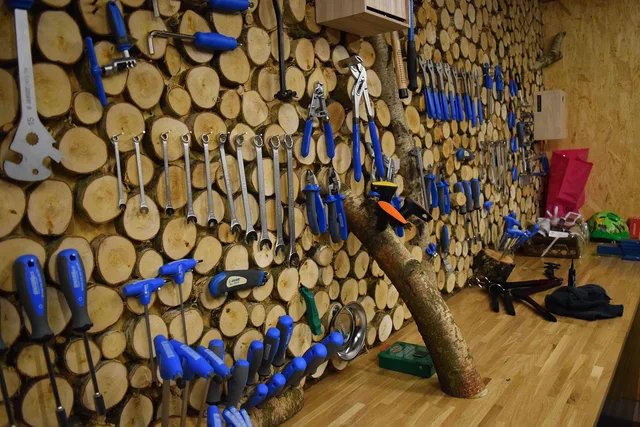
- Permanent:Keep the woodworking bench and French cleat wall storage anchored to studs in place. These are the fixed work surface and storage.
- Rolled out for use:Put a benchtop drill press or shop vacuum on a suitable mobile base if you need to move it between tasks; park it out of the way when you are done.
- Stored flat:Fold and store sawhorses and a folding assembly support when they are not in use.
Sort Every Item Honestly
- Permanentbench, wall storage, lighting, extraction point
- Rolled outsaw, planer, sander, extraction unit
- Stored flatsawhorses, sheet goods, long clamps
- Ten minutes to free means permanent
A tool in the wrong category is what makes a small shop feel impossible. A machine that is technically mobile but takes ten minutes to free is really permanent, and should be placed as such.
Build upward, but anchor properly
Wall storage is the main lever in a small room. It is also where small shops become dangerous, because heavy items end up on fixings chosen for pictures. Find the studs or use anchors rated for the substrate, put weight low and light items high, and keep anything overhead away from where you stand.
Tall cabinets and open shelving units tip. The Consumer Product Safety Commission's Secure Furniture and TVs: Protect Children guidance is aimed at family homes, and a garage shop with children in the house is exactly that. Anchor tall storage to the wall before loading it. The guidance does not give shop-shelving load ratings, so follow the shelving and anchor manufacturers' instructions for the materials and loads involved.
Share the space honestly
If the car comes back, the shop stops at the tire line.
If the laundry is in the room, dust control is not optional. Lint is a fire consideration near heat sources. If a boiler or water heater is in the space, keep finishing, solvents, and fuel well away from it. Treat any pilot flame or burner as a permanent ignition source in your planning.
Write these constraints on the plan. They are the reason otherwise good layouts fail after a month.
Protect the way out
Small rooms block exits fast. Keep the door swing and the route to the exit clear throughout the project.
For workplaces, OSHA's exit-route standards, 29 CFR 1910.36 and 1910.37, address exit-route design and maintenance. The exit-route maintenance rule, 29 CFR 1910.37, requires routes to remain free of obstruction and clear of materials or equipment. These are employer requirements, not homeowner rules, but the habit belongs in a garage. Nothing is stored in the door swing or parked in front of the exit while a finish cures.
Measure the bench footprint, tool bases, stock lengths, door swing, and machine infeed and outfeed in the actual room; use each machine's manual for its operating clearances. Our realistic workshop layout plan covers planning the room, and our comparison of work surfaces for home workshops helps you choose the bench.