Industry
Before-and-after workshop makeovers leave things out of the photo
What before-and-after workshop makeovers show and what they leave out: the four changes that do the work, and the running costs a photo never mentions.
What to take away
- Four changes do almost all the work in a makeoverlight, power, floor and storage. Everything else is finish.
- A before-and-after photograph shows tidiness, which is a state, not a system. Ask what routine keeps it that way.
- Makeovers add running costs. Heating, lighting and extraction all appear on a bill that the photo does not show.
- Sealing and insulating a shop changes its air, and warmer is not the same as healthier.
We describe no particular makeover here, because we have visited none and cannot verify anyone's before-and-after.
The four changes that actually matter
- Light. More light, at more angles, changes accuracy and fatigue more than any tool purchase.
- Power. Circuits and outlets where the tools stand remove the cord and adaptor problem permanently.
- Floor. A sealed, light-colored floor brightens the room, sweeps clean and stops grit grinding underfoot.
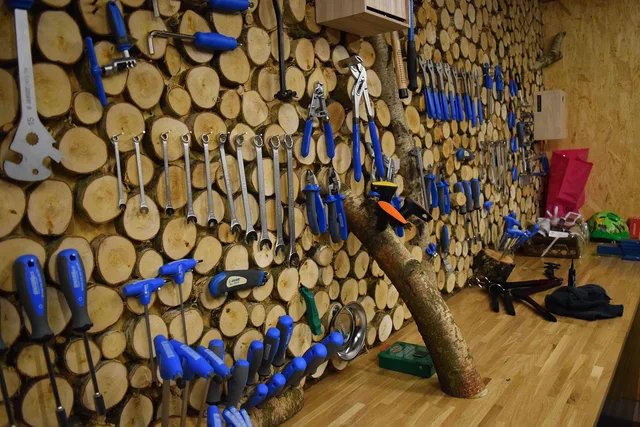
- Storage. Wall and vertical storage returns floor space, which is the resource a shop runs out of.
If a makeover post shows a transformed room but does not mention these four, it is a tidy-up with paint. That is not worthless, and it will not last. Fine Woodworking's Shop Tours series is a named example: real shops, with their owners on camera.
Four changes that matter
- Lightmore light, more angles
- Powercircuits and outlets at tools
- Floorsealed, light-colored, sweeps clean
- Storagewall and vertical storage
What the photograph leaves out
Ask five questions of any makeover you find:
- How much light did the room gain, and from how many angles?
- What changed in the powernew circuits, more outlets, or cords hidden behind the bench?
- Is the floor sealed, and what sits under it?
- Where do offcuts, dust and long stock live now?
- What keeps the room tidy on an ordinary working day?
Five questions for makeovers
- How long did it take?
- What was thrown away?
- Who did the electrical work?
- What does mid-project look like?
- What routine keeps it looking like that?
The last one matters most. A shop photographed the day it was finished tells you nothing about whether the storage plan fits the way its owner actually works.
Makeovers add running costs
Heat is the usual surprise: an insulated garage with a heater is more pleasant and more expensive, and portable heaters bring their own hazards.
The Consumer Product Safety Commission's guidance on portable heater safety includes these habits. Keep combustibles clear of a heater, plug directly into a wall outlet rather than an extension cord, and never leave it running unattended. In a sawdust and finish shop, those points do more work than usual.
At a typical U.S. residential rate of about 15 to 20 cents per kilowatt-hour, a 1,500-watt portable heater run four hours a day costs about $1 a day. That is roughly $25 to $35 a month. A 5,000-watt garage heater on the same schedule runs several times that.
On the same rate, a 40-watt LED shop light used four hours a day costs about $1 a month. A 1-horsepower dust collector draws roughly 750 to 1,000 watts, so an hour of extraction a day adds a few dollars a month.
Lighting, extraction and charging all add to the same bill. None of it is a reason to skip the makeover. It is a reason to price the room after the makeover, not before.
Warmer is not the same as healthier
The most common unstated consequence of a makeover is reduced air exchange. Insulating and sealing a garage makes it comfortable and also makes it hold dust and vapor longer.
Even at work, this is thinly regulated. In a published interpretation on indoor air quality policy, OSHA says it has no specific standard for general office indoor air quality.
The same interpretation lists 68 to 76 degrees Fahrenheit and 20 to 60 percent relative humidity as office comfort ranges, not as shop rules. OSHA treats temperature and humidity as comfort, not hazards, and points to consensus ventilation standards to remove air contaminants.
The lesson for a home shop is that comfort and air quality are separate problems. Solve the first with insulation, and the second with ventilation.
Our analysis of why setup errors repeat covers the planning failures a makeover often reveals, and our ventilation overview covers the air side.
Common questions
Is a makeover worth doing before I know what I build?
How long does a garage shop makeover take?
What gets regretted most?
Should I photograph my own?
In this guide
- 5 details of home workshop makeovers people missPractical makeover advice: empty the room completely, work in phases, put washing facilities in the plan, and design for the person you will be later.
- Beginner workshop makeover kits need layout tools before power toolsWhat a workshop makeover actually needs: layout and marking tools, fixings for the right substrate, dust control during the work, and eye protection.
- Home workshop makeovers materials: floor, walls, insulationHome workshop makeovers materials: epoxy, polyurethane and polyaspartic floors, plywood or pegboard walls, fiberglass, mineral wool or foam insulation.
- Why do workshop makeovers go wrong when cosmetics come first?The errors that spoil a shop makeover: cosmetics before infrastructure, storage built too early, alarms moved, and young helpers put on the wrong machine.
- 5 things about home workshop makeovers worth your timeHome workshop makeovers comparison: assess the base, set bench height, plan a temporary surface, protect the top, and choose plywood over glass.